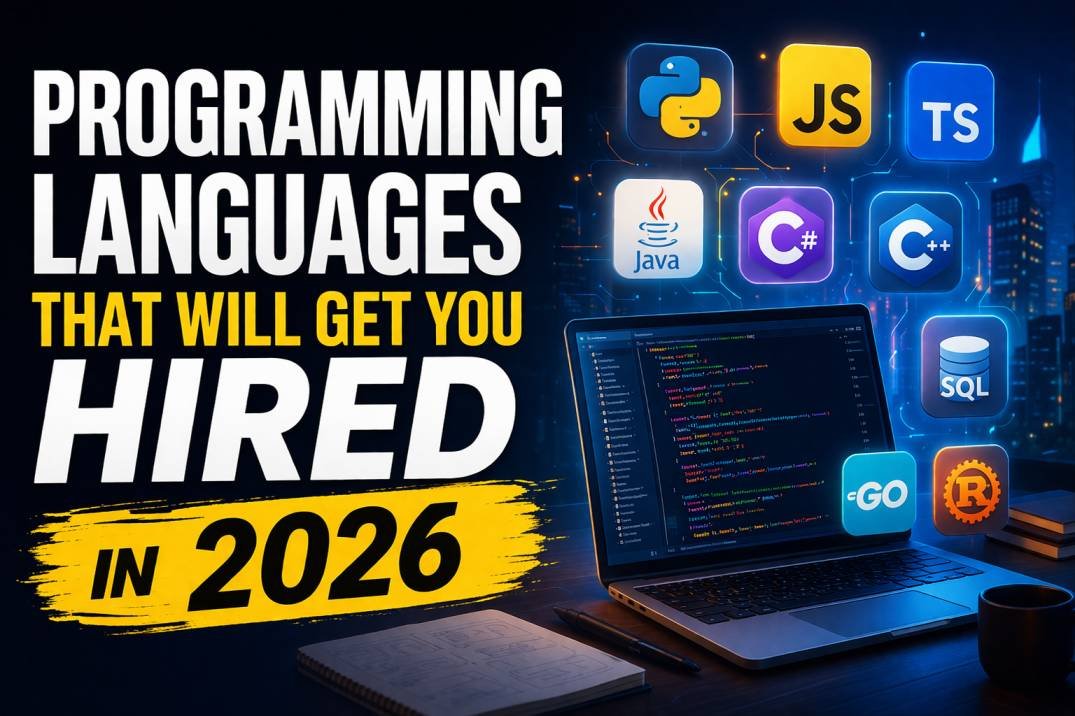
Whether you’re just starting out in coding or already have some experience, there’s one question that keeps popping up: Which programming languages should I learn in 2026?
You’ve probably seen headlines claiming that AI is taking over, junior developers are being replaced, and companies only want senior devs. But the reality is different, and the data tells a clearer story. In this article, we’ll break down the current job market, show which languages are in demand, and give you a roadmap to boost your chances of landing a job.
Before we dive in, a quick note: learning a single programming language alone won’t automatically get you hired. Most jobs expect you to know multiple languages, understand some frameworks, show problem-solving skills, and build real projects. But it all starts with the same question: Which languages should you learn first?
Are Junior Developer Jobs Gone?
Short answer: no, but the bar has risen.
The past few years were tough. Between mass layoffs in 2022-2023, economic uncertainty, and hiring freezes, entry-level developers were hit the hardest. Many thought junior roles were disappearing, but the numbers tell a different story.
By late 2025, signs of a rebound appeared. Litecast reports that developer job listings for 0–3 years of experience rose 47% since October 2023. In the US alone, there are around 24,000 open entry-level software engineering positions on Indeed.com, and that doesn’t include internships or startups hiring outside major boards.
Globally, the demand is even stronger. Europe faces a tech talent shortage: 57% of companies report struggling to find qualified developers, and the EU needs nearly 10 million more tech workers by 2030.
The catch? Companies now expect juniors to be productive faster. With AI tools integrated into workflows, they’re looking for developers who truly understand code, can solve problems, and make smart decisions, not just copy and paste snippets.
Why Fundamentals Matter
Understanding fundamentals is more important than ever. This isn’t just about memorizing syntax. It’s about:
- Core data structures: arrays, lists, dictionaries, stacks, queues—and knowing when and why to use them
- Debugging and problem-solving
- Basic design patterns, version control, and database concepts
You don’t need a computer science degree, but you do need that level of understanding to thrive in today’s job market.
Top Programming Languages for 2026 :
1 – Python
Python isn’t just popular, it’s everywhere. From AI and machine learning to backend development, automation, and data analysis, Python’s versatility is unmatched.
Usage: 58% of developers (Stack Overflow 2025)
Job openings: 100,000+ in the US alone
Python is easy to learn, allowing you to write real code quickly and focus on building projects, something employers value highly. If your goal is AI, data, or machine learning, Python is a smart first choice.
And here’s a course for beginners to learn Python from scratch, it covers installation, the interpreter, and essential code editors. You’ll also explore your first Python program and key concepts like variables and strings.
2 – JavaScript & TypeScript
JavaScript is the backbone of the web, and TypeScript adds type safety for large-scale applications.
Usage: 66% of developers (Stack Overflow 2025)
TypeScript is now the default for many production teams, improving code quality and maintainability.
For anyone wanting to build websites, dashboards, or full web products, JavaScript and TypeScript are essential. and we already covered this in another article check it up for yourself (Choosing the Right JavaScript Course for You)
3 – Java & C#
These languages may not get the hype, but they power a huge part of enterprise software.
Java: Widely used in finance, government systems, and large-scale applications
C#: Common in Microsoft environments, desktop software, cloud services, and Unity game development
They have a steeper learning curve but offer stability, long-term projects, and high-paying roles.
4 – SQL
Not flashy, but indispensable. Every serious application relies on data stored in databases, user accounts, orders, logs, analytics, and more.
SQL appears in 100,000+ job listings in the US, often alongside Python, Java, JavaScript, or C#.
You don’t need to be a database expert, but understanding SQL makes you immediately more valuable and lets you build realistic projects beyond tutorials.
Bonus Languages:
These are optional but powerful if you have specific goals:
- Go (Golang): Cloud, microservices, DevOps, backend systems
- Rust: High-performance, safe systems and security software
- Swift & Kotlin: iOS and Android app development
Pick them based on your target projects, cloud, low-level software, or mobile apps.